Showing posts with label special needs. Show all posts

Saturday, March 29, 2014

Let's get 'graphic'


And some "women's advocates" in my country are stubbornly pushing for a law that ignores all these.

I sure hope my faith -- and that of many others -- in the Supreme Court of the Philippines to do the right thing and uphold the Constitution will be justified. April 8 -- the crucial date.


Saturday, July 27, 2013

Two pages from the past

Borrowing a few old issues of Baby magazine from Petrufied led to a brief reminiscence. After poring over the pages, I recalled experiences which showed that being part of such a project was such a privilege. Charming babies aside, it was the aim to support, guide and inspire young parents (and entertain them along the way) that kept us grounded in our responsibility.

I haven't even bothered to count how many editorial notes I wrote in my four years at Baby, but even if just a handful of readers found any of them helpful in any way, I'm happy. Here are two of my favorites. The second one I remember well since a mother wrote us and said that she didn't even wait to get out of the bookstore to tear open the plastic wrap carrying the magazine, as the issue theme -- Babies with special needs -- was relevant to her family's circumstances. Was I touched to know that the note I wrote drove her to tears -- in a good way, I believe.

Reading both notes below -- written in 2011 and 2008, respectively -- made me realize they both dwell on that most important element in life: love. Well, what can I say? It does make the world go round as it is the essence of life for anyone who aims to live and not merely exist.

If you'd like a glimpse of the Beatles-inspired cover, here it is.


Finding love here, there & everywhere

When two of my US-based nieces were toddlers, their parents flew them over to spend six months with us Manila-based folks. During that time, one of the things that we occasionally did was sing together while someone accompanied the singing on the piano. Tammy and Michelle had a jolly good time every time, no matter what the songs or how off-key we got. But there were two songs that had the sisters rapt in attention whenever these were belted out. Michelle gazed in wonder as soon as she heard "Michelle, ma belle, these are words that go together well, my Michelle..." and sat, fascinated, sometimes bobbing her head, till the end. Tammy gave more or less the same reaction whenever we'd launch into an old Debbie Reynolds song (actually, it was my mom who knew it and the rest of us just sort of hummed along) called "Tammy," probably fascinated how her name figured into a "real" song.

Perhaps having their "very own song" sung to them felt like another manifestation of how the world revolved around them, which is somewhat how young children see life -- which is how each of us starts out till we gradually mature with the help of our parents into learning to adjust to the big world of which we are part. Dwelling on this memory now makes me think about love and how a person who believes the world revolves around him would find it difficult to love. Why? Because the essence of love is being other-centered, and what has a self-centered grownup to offer others if he is always absorbed in satisfying his own wants and needs? Sure, affection, understanding, laughter, gifts, sympathy, forgiveness -- these are elements that are part of the good relationships anyone (self-absorbed or not) maintains with loved ones. But genuine love is much more than that, and it's one thing to love when everything is smooth-sailing, and another to love during the times when it becomes difficult to do so.

I'm pretty sure we're addressing some real concerns in this issue that you parents have in mind. Responsible parenting has been an "explosive" issue lately and we hope our take on natural family planning in "Recipe for success: The Billings Ovulation Method -- What? Why? How?" (page 22) empowers you to know more about your fertility, understand yourself and your spouse, and see how God has wonderfully designed the human body and taken care of everything so that -- if we do our part -- even our health is protected when we let nature take its course. Also along the lines of good health are "The bedtime story: Is sex during pregnancy safe for mom and baby?" (page 24) and "A perfect (and healthy!) Valentine's date (page 28), both delving on crucial matters as well. Whether the situation with your spouse right now has you singing the Beatles' "All my loving," "Please please me," or "We can work it out," you're going to have to learn these matters sometime, so you can start right on our pages!

Now, if dealing with your in-laws has your musical radar reflecting the likes of "Help!" and "Give peace a chance," by all means sing your heart out! But do turn to page 57 while you're at it and be heartened by "Happy ever after... with your in-laws" and know that there is always a way to make things better.

Love starts out simple -- we are, after all, created to love -- but gets complicated along the way. However, since it's how much we've loved that matters in the end, shouldn't our days' soundtrack run along the lines of "...I don't care too much for money, money can't buy me love"? Then, amid the challenges with the spouse, the kids, the in-laws and everything in between, will you be able to sing "In my life, I've loved them all..."? 


* * * * *


"Kahit ano, basta normal"

One of the punishments that come with watching interviews with celebrities on local television is listening to mundane questions, to which are often given just as mundane answers. Besides the standard "What's your wish for (celeb's name) on her birthday?" "Sino ang gusto mong maging leading man/woman?" and standard lines such as "Sana po panoorin n'yo ang (movie title), napakagandang pelikula," there's one line I'd been hearing for years that I always found strange, even as a 10-, 11-year-old. It's the title up there, which was the reply often given by pregnant or newlywed guests to hosts who had just asked "Ano'ng gusto mo, boy o girl?"

After hearing the answer, I'd always wonder, "Pa'no kung hindi normal, hindi niya mamahalin ang anak niya?"

Well, I think nobody on the verge of parenthood asks to be given a child with mental, physical or developmental disabilities (save for a handful of couples in the United States I have read about who have purposely selected babies with Down Syndrome for adoption, prompted by compassion and a desire to give more of themselves to the demands of parenthood), but I couldn't help but think -- even as a child -- that something was very wrong about making a declaration like "Kahit ano, basta normal" (and for the entire viewing public to hear at that). 

It's not that I was touchy about having  a sister who has Down Syndrome (DS). If I were, I probably wouldn't have grown up gleefully pointing out to her the little girl with DS on those Sesame Street episodes every time she appeared, or delightedly told my older siblings repeatedly that the girl hobnobbing with the muppets or Maria and Bob looked so much like our sister.

People with DS, autism, Attention Deficit Hyperactivity Disorder (ADHD), dyslexia, and several other conditions have come to be called "special needs" persons. "Special children" is how others refer to the little ones. Giftedness falls under the category of special needs as well because dealing with a gifted child does present with it unconventional situations that require special approaches and courses of action.

But then the human race isn't composed of automated robots; who, then, isn't special in one way or another? Some need lenses to read, others carry on with food allergies, a scoliotic condition or difficult pregnancies. There are those who deal with phobias, or have "photographic memories" or tower over the rest of the population at over 6 feet. Whether it's physical, mental or psychological, individual differences have always been there. It's only in our time that the term "special needs" came into vogue.

Also during our time, a lot of headway has been made in terms of research, evaluation and treatment. In this issue of Baby, you'll read accounts of families who have taken advantage of this wealth of information and other resources now at our disposal. We would've wanted to fill these pages with medical information and all there is to learn about special conditions. But I think what will have more of an impact are stories of real people who are experiencing the challenges of parenthood under special circumstances, how they're turning perceived obstacles into stepping stones, and what practical steps they've taken to address their particular situations.

Individual differences indeed we have. A person with special needs, however, such as those with conditions I've mentioned, carries in himself the same dignity as the next person. Being born with DS or autism or an extremely high IQ does not in any way diminish one's worth as a human being; being entrusted with a special-needs child can certainly increase a parent's capacity to love, sometimes even surpassing one's expectations. So, if you find yourself wondering (maybe lamenting?) why -- of all mothers -- a special child was given to you, it's possible it has something to do with love (lots of it) that you didn't know you had in you, a child who needs it in a way that only you can give.

* * * * *


Saturday, November 12, 2011

No hands, no problem

At just about this time a week ago, I was having dinner with someone who ate with her feet. That doesn't sound like a very pleasant meal to partake in, does it? I'd surely have the same impression had I not been the one chatting over lettuce soup and (my) baked fish in olive oil with a person whom I believe is worthy of much respect beyond the common respect that each human being deserves.

Jessica Cox was born without arms, and before she reached her 28th year she had already been swimming, scuba-diving, doing taekwondo, and driving with a no-restrictions driver's license. Then in 2009 she obtained her pilot's license. Now, this is just a fraction of the activity she's been engaged in, about which you can discover more here and here. But what I really think is important about this opportunity presented to me to spend a few hours with Jessica is the way I experienced starting off trying to overlook a physical condition and eventually forgetting that it's there without even trying.

A few of us met Jessica -- a Filipino-American who was in the country on vacation -- at her hotel to do an interview. I think it was when she casually flicked on an air-conditioning switch which was around eye-level using her foot that I began to feel a strange mix of "Oh, inconsiderate me, I should've done that" and "Wow, she can do that." After that was the interview during which she related stories of growing up in the US with her parents and two siblings, doubts she had experienced and assurances she had been given over the years, the traveling she's been doing to get her motivational message across to those who could benefit from it, and basically the wonderful upbringing that her parents carried out.

It was easy to lose sight of the fact that physically she was incomplete, but boy, what grit. And yet, I sensed no overly aggressive sentiments or any kind of defensive attitude that could have been a natural outcome of being regarded as "too different for comfort" -- which is very well a possibility given most societies' lack of understanding of special conditions or exposure to differently-abled people. But Jessica was composed, well-adjusted, pleasant. By the end of the interview, though her physical condition remained, what was more pronounced to me was her character.

I was momentarily reminded of her special condition, though, after she got some postcards to autograph for us. I was surprised for a few seconds, then thought, "Oh yes..." because prior to the interview I had seen pictures of her brushing her hair, putting on contact lenses and writing with a pen -- all using her feet.

We talked a lot over dinner, and though I was initially surprised the moment she took a sip of the soup from the spoon (of course, brought to her mouth using her right foot), it became unnoticeable to me right after that. Too bad we couldn't really take our time during the meal on account of another appointment that left less than an hour for dinner.

I can't even say that it was a memorable dinner, though I will never forget it. By the time of the meal, I had already grown accustomed to her -- the whole person -- so that whatever "spectacular" thing about such an experience may have normally stayed with me, simply went to my heart. That does sound somewhat cheesy, but I think spectacular things simply go up and fade away easily, while experiences that make their way into the heart stay and are felt in some ways long after they happen.


And the autographed postcard she gave me -- I guess it's simply a reminder of the strength of the human spirit and what heights we can reach when perceived obstacles are regarded as gifts and are used as stepping stones. Since one of the photos on the postcard shows the Pope, I'll let that be a reminder that it's with faith that everything begins -- even the belief that one can write with a pen despite the absence of hands.

Sunday, September 12, 2010

A special edition

I can't help but think back to days when the cover shoots I took part in normally involved people whom society refers to as "celebrities." Whether I was a freelance/staff writer assigned to interview the subject, or one of the editors tasked along with the rest of the team to come up with a striking cover concept, having a celebrity as part of the package always meant a certain degree of... shall we say, "studied spontaneity" in front of the camera. At least in my experience. I say this because I now have the benefit of perspective, seeing things in the context of the kind of pictorials I have been taking part in since joining Baby Magazine three and a half years ago.

Capturing images of a person accustomed to kleig lights, to doing and saying things for a crowd, and to the attention/open admiration of fans, is radically different from that of a person who is still beginning to get acquainted with his immediate surroundings. There is also a world of difference between being able to tell someone to hold a certain pose (and to ask him to do the pose again) and being at the mercy of a little person who has no concept of poses and to whom requests of poses will make no sense. A model is trained to project in front of a camera; a baby goes about with complete spontaneity. Which is why when a baby ends up flashing a most adorable and animated expression, while still being natural -- and long enough for the photographer to capture it -- it is always a cause for celebration and thanksgiving!

The cover shoot for Baby mag's September issue took place on a Tuesday afternoon. We decided to do it at the family's home instead of the previously decided play facility in a shopping mall so as to put 19-month-old Tio completely at ease. We wanted him relaxed, comfortable and happy. I think we succeeded in that.


For one thing, his entire family was there (even an aunt and cousin dropped by to join the fun). Also, there was no need for him to adjust to a new environment since he was completely familiar with everything in sight. The only "new elements" were the Baby mag staff who were there plus photographer Karen Ilagan.


So, when it was time to play over at the "little blue playground thing" in the garden, Tio was all set and raring to go! His mom said the Little Tikes play set was part of the boy's physical therapy sessions for months, which started when Tio was barely a few months old.


Obviously, he was having the time of his life :-) The minutes we spent out in the garden, after all, were during the latter part of the shoot, after he had warmed up considerably and was probably regarding the whole experience as mere play. Here he is with his mom as we were about to wrap up --


Earlier, he probably found it weird that we seemed to be trying to keep him entangled between his mom's knees and attempting to have him stay on the floor the whole time! He was pretty dynamic, though! He wiggled, he crawled, he broke away from his mom, then for some moments he would smile, stick out his tongue, cover his mouth or wave at his "fans" who were cajoling him the whole time. Then we moved him back again, far enough from the camera in case he broke free and crawled his way toward the photographer. This was the routine for quite a while.


Photographer Karen was one patient shutterbug! She gamely waited, slid across the floor to catch a good angle, called out to Tio to coax a smile, shot away, called out some more, laughed with us everytime the little boy did something amusing. And she was quick to keep shooting when Tio -- as I personally had been hoping and praying for -- stayed put for close to a minute, I think, seated beneath his mom's legs, looking happy and animated. Was it going to be a good shot?


I think we got six or seven shots framed almost perfectly, in the way we were hoping for. We selected what we deemed the best one, where the charming 19-month-old boy with the extra chromosome that made him even cuter, looked absolutely happy and contented, just like the way a child who is loved and cared for by his parents and siblings ought to look.
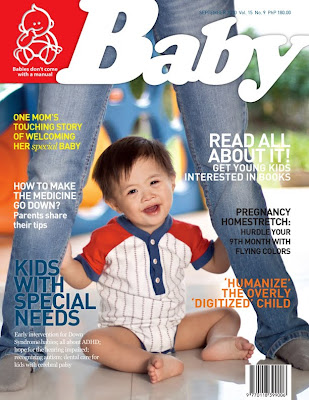


Baby magazine
is published by Marathon Publishing Co. and is sold at major National Bookstores, all SM baby department stores, Babyland (Robinsons Galleria, Shaw Blvd. near Cherry Foodarama and Eastwood Mall), Bufini, Mio Magazine Shops, selected Powerbooks outlets, and Big & Small Co. Shangri-la Mall.

Saturday, October 17, 2009

Specially for you

Anybody who cares for a person -- whether a child or an adult -- with special needs knows that the responsibility comes with challenges that require more patience and creativity. Is he a brother? A sister? A son? A daughter? A friend? I think each of us knows somebody who has "a little something extra" (as teacher and book author Barbara Curtis has put it when referring to people with Down Syndrome) or is lacking in something, making them different from others in more ways. Thank God we can rest assured that the value of every person's life depends not on what he can do but on what he is -- a child of God. And for any creature there can be no higher dignity than that!

It may also be comforting to know that even though most kids with special needs have a more limited ceiling when it comes to the level of understanding and intellectual capability or of physical tasks that they can carry out, the joy and the sense of wonder their presence can bring about in those around them, are limitless. That, and the depth of self-giving that they can enable their families and caregivers to reach.

This may provide some boost and assurance to those who spend a lot of time with people with special needs. I think it also gives us a deeper insight into things that special people also need (and feelings they may experience) which we have taken for granted or probably aren't aware of to begin with:


Beatitudes for friends of special needs kids

Blessed are you who take time to listen to difficult speech:
For you help us to know that if we persevere,
We can be understood.

Blessed are you who walk with us in public places,
And ignore the stares of strangers,
For in your companionship,
We find havens of peace.

Blessed are you who never bid us to "hurry up",
And more blessed are you
Who do not snatch tasks from our hands to do them for us,
For often we need time rather than help.

Blessed are you who stand beside us
As we enter new and untried ventures,
For our failures will be outweighed
By the times we surprise ourselves and you.

Blessed are you who ask for our help,
For our greatest need is to be needed.

Blessed are you when you assure us,
That the one thing that makes us individuals
Is not in our peculiar muscles,
Nor in our wounded nervous systems,
Nor in our difficulties in learning,
Nor any exterior difference.
But is in our inner, personal, individual self
Which no infirmity can diminish or erase.

- Author Unknown


H/T: MommyLife

Saturday, May 05, 2007

Staying true to his calling

From "Saintly scientists: Hate the disease, love the diseased," by Caroline Moynihan, writing about one of the fathers of modern genetics, the Frenchman Dr. Jerome Lejeune. She quotes the scientist, whose process for beatification has recently been opened:

"With their slightly slanting eyes, their little nose in a round face and their unfinished features, trisomic children are more child-like than other children. All children have short hands and short fingers; theirs are shorter. Their entire anatomy is more rounded, without any asperities or stiffness. Their ligaments, their muscles, are so supple that it adds a tender languor to their way of being. And this sweetness extends to their character: they are communicative and affectionate, they have a special charm which is easier to cherish than to describe. This is not to say that Trisomy 21 is a desirable condition. It is an implacable disease which deprives the child of that most precious gift handed down to us through genetic heredity: the full power of rational thought. This combination of a tragic chromosomic error and a naturally endearing nature, immediately shows what medicine is all about: hatred of disease and love of the diseased."


Read the whole thing at MercatorNet

Sunday, January 21, 2007

Chromosome #21

I found this in the archives while navigating Mommy Life. The photo is recent, though, taken during Christmastime 2006 and shows Barbara with her husband and some of their 12 children. They've welcomed four kids with Down Syndrome into their happy home -- one by birth (Jonny, whom she writes about here), three by adoption.

Excerpts from "About that exra chromosome..."

My son Jonathan has a little extra. A little extra enthusiasm, a little extra innocence, a little extra charm. Oh, and did I mention an extra chromosome? The one on the 21st pair that inspires so much fear in parents-to-be.

I suppose at one time I was fearful about Down syndrome. But in 1993 when they placed the blue-blanketed bundle in my arms and I could see he looked - well, just a little different - I actually felt a sense of awe. Here will be a challenge - so many things to learn.


It helped that we already had a few "normal" children. But other things had opened my heart as well. There was Amy, a six-year-old cutiepie we babysat for now and then. Amy's dad had left shortly after her birth - just couldn't get into having a daughter with Down syndrome. On the brighter side was the dad and daughter duo I'd seen a month before riding the merry-go-round. A gleeful almond-eyes three-year-old, a father helplessly in love. There's something special here, I thought.

...

My son Jonny, now 12, is a snappy dresser and an avid movie/Broadway buff, with a repertoire including songs from Phantom of the Opera, Annie, Bye, Bye Birdie and more. He loves people of all ages, but babies make him turn to mush. He has an uncanny way with animals. He loves school, but that doesn't keep him from loving the thrill of snow days more.

At home or school or church he is the first to offer help, to comfort someone who's down, and to laugh uproariously at the punch lines. His preschool teacher named him Ambassador of Goodwill. His public school kindergarten teacher, after 30plus years of teaching, said she'd never seen children as loving and caring as Jonny's classmates. The secret, she said, was Jonny. When he graduated from her class, she wrote us: "As the Bible says, "The Lord does not look at the things man looks at. Man looks at the outward appearance, but the Lord looks at the heart." Jonny certainly taught the children and me to look at the heart; for he has a very big heart!"

He's been a gift I never would have thought to ask for, bringing lessons I never knew I needed to learn. The greatest surprise is this: Our life together has been less about my helping him reach his potential than about him helping me reach mine.


Read the whole thing at Mommy Life


Monday, September 11, 2006

Taking things in stride Down there

The blogroll at Generations for Life has a new addition to it from time to time. Though I've spotted the Life Training Institute blog on it before, I checked it out only recently. Here's something interesting that I read --

Yesterday, my wife and I saw a specialist in maternal-fetal medicine for a 4D ultrasound on the little one we expect to meet in January. Everything has been progressing as expected, but my wife's ob-gyn wanted a better look at the child and the placenta after 3 previous C-sections.

The doc is a very pro-life individual with an amazing story. His family is raising (or have raised) 12 children. Most of his children are perfectly healthy (he has a son in med school and spoke with me about his desire to do future cleft surgery), and he has adopted a few children with significant developmental challenges. He also has a a biological daughter that I believe doesn't fall into either category. She has Down Syndrome.

Having a physician who has raised a daughter with Down Syndrome talk about possible chromosomal syndromes was very interesting. He gave neither an overly bleak or overly rosy picture of raising a child with Down's. I'm already quite aware of the physical issues with Down's kids, he spoke a lot about the incredible loving attitude that his daughter has. He believes that despite the challenges she has faced, she experiences joy in a way that he can not approach.


Read the rest at the LTI blog

Saturday, August 19, 2006

Sibling revelry


Ain't that cute?

I had posted this photo in my other blog last year to accompany a story about kids with special needs, then saved the photo in my computer -- only to be wiped out by a virus.

Then last week I came across the same picture via Google. I think now is a good time to post it again, if only to serve as a reminder of the joys of childhood and of having siblings -- whether the child is considered one with "special needs" or "regular" needs.

Monday, June 12, 2006

Down but not out

Down syndrome: the positives
Parents, researcher challenge perceptions

Ben Allard hit his dad's underhand pitch solidly and began circling imaginary bases in his Franklin backyard. A 7-year-old with Down syndrome, Ben crossed home plate and celebrated by bear-hugging his younger brother Max . Looking on, the boys' parents, Mike and Beth Allard, shared a smile.

Today, the Allards can't imagine life without Ben, a warm-hearted boy who loves hockey and high-fives. But when doctors told them during pregnancy their child would be born with the genetic disorder, they say their physicians described a life scarcely worth living.

"The way they told you, it was like they were telling you your son was in a car accident," said Beth Allard. "And we had to decide whether to take him off life support."

For parents who have received a Down syndrome diagnosis during pregnancy or at delivery, the Allards' story is probably familiar . Brian Skotko , a joint-degree student at Harvard's John F. Kennedy School of Government and Medical School, last year published two research papers that concluded physicians often relay the news in an overwhelmingly negative way, focusing on the limitations and hardships a child with Down syndrome may face.

Of the 1,250 parents of children with Down syndrome surveyed in Skotko's work, many reported that doctors used insensitive or offensive language in communicating the diagnosis. Many said they were advised to put their baby up for adoption or were scolded for not having prenatal testing to identify the condition.

Skotko, who has a sister with Down syndrome, said that while most parents are understandably shocked by a Down syndrome diagnosis, they need to know that individuals with Down syndrome are increasingly living independent lives.

"Too often, the potential of children with Down syndrome isn't conveyed," Skotko said. "Parents are rarely being told that people with Down Syndrome can live rich, full lives."


Full story at Boston.com


Monday, December 12, 2005

Food for thought for us living in a 'civilized society'


T
he Spine-Chilling Euphemism of the Month Award goes to the Washington Post for its recent front-page headline: "Down Syndrome Now Detectable In 1st Trimester: Earlier Diagnosis Allows More Time for Decisions."

One "decision" is, of course, whether to terminate the pregnancy — the "A" word (abortion, for those not into subtlety). The less-nuanced, terribly un-P.C., and perhaps you'll consider downright mean among us might use a k-word. The decision being over whether to kill an innocent child, who is completely dependent on his mother's choices. Doctors estimate that between 80 and 90 percent of Down children are now aborted once pre-natal tests issue "warnings."

* * * * *

I know abortion is one of our most contentious issues. People don't want to judge. They don't want to put their rosaries on your ovaries. People often just don't want to talk about it. But we have to talk about it. And we have to especially talk about Down Syndrome and abortion — and this class of people "sophisticated" types seem to think can (and should?) be eliminated. A civilized society cannot tolerate this reality.

As Patricia Bauer put it: "What I don't understand is how we as a society can tacitly write off a whole group of people as having no value. I'd like to think that it's time to put that particular piece of baggage on the table and talk about it, but I'm not optimistic. People want what they want: a perfect baby, a perfect life. To which I say: Good luck. Or maybe, dream on."


Defining Life Down: Are we okay with eliminating a class of humans?
Kathryn Jean Lopez, National Review Online


Friday, December 09, 2005

This bud's for you


Best Buddies Deutschland ist Mitglied bei Best Buddies International, dessen Mission darin besteht, die Freundschaft zwischen nicht behinderten Schülern und Studenten und jungen Menschen mit geistigen Behinderungen zu fördern.


There's a bit of German for you, hehe. But anyway, the English translation follows at the Best Buddies website.

Here's a moving article about how perceptions of some high school students were changed for the better, thanks to a special education teacher.

Best Buddies bring Mt. Lebanon student body together

Thursday, November 10, 2005

By Mary Niederberger, Pittsburgh Post-Gazette

Special education teacher David Breier had been looking for quite some time for a program that would integrate his students with the rest of the student population at Mt. Lebanon High School.

This fall, with the help of junior Elizabeth Lisowksi, 16, a cheerleader and student council member, a local chapter of Best Buddies International, a group that pairs special needs students with able-bodied students, was founded at the high school.

It didn't take long for Mr. Breier to see the program was just what he had been looking for.

At the homecoming dance last month, cheerleaders, football players and other student leaders invited the special education students, who traditionally congregated in their classroom, onto the dance floor with the rest of the student body.

Both groups of students danced so hard that, Mr. Breier said, he started to worry that some would dehydrate. But that, he said, was a good problem.


Full story at Post-Gazette.com


Related Posts Plugin for WordPress, Blogger...