
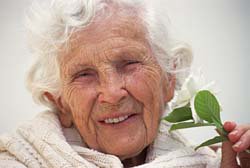
Read Kids learn kindness from Grandma in the window
Kevorkian: “The Single Worst Moment of my Life … Was the Moment I Was Born”
By James Tillman and John Jalsevac
June 15, 2010 (LifeSiteNews.com) -- "The single worst moment of my life . . . was the moment I was born." So says Dr. Jack Kevorkian in a recent interview with CNN.
Dr. Sanjay Gupta, the journalist conducting the interview, confessed that the remark left him speechless – especially since Kevorkian offered the strange and macabre confession without any provocation or lead-up question.
Gupta writes that, “Throughout the two-and-a-half hour interview, [Kevorkian] fluctuated wildly between being downright combative and hostile to being sweet and fatherly.”
The journalist also mentioned Kevorkian’s “crazed rants,” “often about the Ninth Amendment to the Constitution, complete with a defense of James Madison and trashing of Thomas Jefferson.”
The interview is part of the lead-up to Kevorkian’s Thursday interview at 9 PM EST on Larry King Live.
Kevorkian or "Dr. Death" has helped approximately 130 people kill themselves. He also spent 8 years in prison for the second-degree murder of Thomas Youk, who was in the final stages of Amytrophic Lateral Scelerosis at the time of his death. Kevorkian had given Youk the lethal injection himself, and, in a videotape of Youk's death, dared authorities to try to convict him.
Kevorkian told Gupta that he believes his case should have been heard by the Supreme Court, because the issue of assisted suicide is a constitutional issue. Everyone, says Kevorkian, should have the right to kill him or her self.
"They just don't get it in Oregon, " he says. "Or in Washington state or Montana, the other states," where assisted suicide is currently legal. Assisted suicide is only legal in these states if someone has a terminal illness.
"What difference does it make if someone is terminal?" he says. "We are all terminal."
Five of Kevorkian's victims were found to be healthy after autopsies were performed.
Full article at LifeSiteNews
 ...is something to be cherished. But I wouldn't want to be any of these children. "Because I want to" seems to be the driving force behind the actions of some parents -- particularly those involved in these incidents. I can't read minds, which is why I have trouble seeing anything noble in the intentions behind what they have done.
Motherless by decree
I don't think P.D. Eastman imagined in her wildest dreams what this question could dredge up legally, ethically, and medically within fifty years of the publication of her classic children's book.[An] unmarried man, Roberto d.B, had made arrangements with an unmarried woman friend to have her eggs donated to him for the purpose of being fertilized in vitro (outside her womb). (It is unclear whether the eggs were fertilized by his sperm.) And he had made arrangements with a second woman (the "gestational carrier" or "surrogate mother") to have her carry the embryos to term. (Although the decision states she had family responsibilities, it does not state whether she was married or had sexual relations with any man during the relevant time; if she were married, there would have been an issue about whether her husband was the father of the twins.) When the second woman delivered the fraternal twins in 2001, the hospital reported her as the mother. The man sued to have her name removed and his name listed as sole parent, the father. They both argued that she had no genetic link to the children and never intended to be their mother. The trial court agreed to add his name as father, but to retain her name as mother. An appeal was taken.
So legally, now, these are two six-year-olds with no mother, birth certificates with blank spaces, and a psychological nightmare that only God can heal.
It is clear that the court implicitly held that, although the twins were delivered from the womb of this woman, she was not their mother. There can be only two reasons for so holding. One is that she did not intend to be their mother, but the court expressly states that her intent is not a factor in establishing or not establishing parentage -- any more than it is for men. The alternative justification for this implicit holding is that she was not genetically linked to the children and therefore could not be their mother.
Aint this grand. The deconstruction of gender and consequent restructuring of family and rights allow these two children to be hatched at the whim of a man with a mission to use his seed to stick it to the system.
Read the rest of Motherless by decree at Feminine Genius
CLASSICAL HITS 'HELP' TEENS WITH HOMEWORK "These figures prove that today's iPod generation is increasingly turned on by classical music," said Classic FM's managing director, Darren Henley. "Mozart and Beethoven remain as relevant today as they were in their own lifetimes." Peak time for young listeners is between 7pm and 9pm -- when they use the music to "chill out and relax" while doing homework -- and the station has been targeting them with their own request shows. "More than 70 per cent of the requests we get are from students taking exams and tests," says Mr Henley. How well they do is another question. ~ London Telegraph, May 12  Teenagers who insist that listening to music helps them study are at least beginning to show good taste. New radio listening figures in the United Kingdom show that nearly half a million under 15-year-olds tune in each week to the Classic FM station -- reflecting growth of 100,000 a year in recent years. The surge was initially fuelled by interest in sound tracks from films like Harry Potter and Star Wars, but word of mouth seems to have taken over.
--------------------------------------------------------------------------------
AGEING GERMANY BUILDS PLAYGROUND FOR SENIORS  Ageing Germany is not going to be allowed to sit back and worry about the dearth of children. The country's first playground for seniors has been opened in Berlin, inspired by public exercises seen in China. The equipment in Preussen Park is designed for people at least 1.5 metres tall, and children can only use it with adult supervision. Simple gym equipment made of stainless steel is laid out on a layer of bark under a canopy of trees. The gear includes a flexibility machine, a leg trainer and a back-massage machine. Total cost 20,000 euros -- one quarter of the cost of a children's playground. ~ Der Spiegel, May 9
NEW YORK -- It was every subway rider's nightmare, times two.
Who has ridden along New York's 656 miles of subway lines and not wondered: "What if I fell to the tracks as a train came in? What would I do?"
And who has not thought: "What if someone else fell? Would I jump to the rescue?"
Wesley Autrey, 50-year-old construction worker, faced both those questions in an instant Tuesday, and got his answers almost as quickly.
Autrey was waiting for the local at 137th Street and Broadway in upper Manhattan around midday. He was taking his two daughters, Syshe, 4, and Shuqui, 6, home before heading to work.
Nearby, Cameron Hollopeter collapsed, his body convulsing. Autrey and two women rushed to help. Hollopeter, 20, managed to get up but then stumbled a few steps to the platform edge and fell to the tracks, between the two rails.
The headlights of the No. 1 train appeared.
"I had to make a split[-second] decision," Autrey said.
So he made one, and leaped.
Autrey lay on Hollopeter, pressing him down, his heart pounding. The train's brakes screeched, but it couldn't stop.
Full story at Chicago Tribune
Graying Japan opens doors to RP nurses, caregivers
The Philippine Star 01/04/2007
 TOKYO (AFP) – Ask wheelchair-bound 81-year-old Hisae Kajiwara about the new workers at her nursing home and a smile comes to her face.
"They are really cheerful and make the atmosphere here very bright," she says.
Another woman, 79-year-old Mitsu Sekiguchi, also confined to a wheelchair, chimes in: "And they always make the beds just perfectly."
Normally, the arrival of new nurses at the care facility in Tokyo’s western fringes would be a mere question of personnel. But this time, it represents a fresh step for Japan.
Maria Falqueza, 25, and Olivia Pineda, 30, are among the first Filipinas at nursing facilities in Japan, which has signed a free-trade agreement with the Philippines that broke precedent by allowing workers to come in.
A handful of care support facilities have accepted 15 Filipinos including Falqueza and Pineda as trainees to brace for the full-fledged entry of Filipino nurses to Japan.
After intense negotiations, then Japanese prime minister Junichiro Koizumi and President Arroyo signed a deal in September for Japan to accept up to 1,000 care workers and nurses from the Philippines in two years.
Full story at The Philippine Star
As with so much contemporary legislation, the law is only seeking to fill a gap left by the vacuum in custom and manners. When we see a warning notice at a toll booth, a check-in desk, or even on a bus, saying that employees are entitled to carry out their work without being threatened by violence or verbal abuse; or when there is a sign at a post office informing customers that they must switch off their mobile telephones while speaking to the person serving them – this is the law is trying to teach manners and respect.
We should not have to be told that it is rude to conduct a phone conversation while dealing with the person behind a counter; or that it is unacceptable to swear or verbally abuse a bus driver or someone otherwise serving the public. But where manners and custom fail, the law now tries to step in. Yet the law is often blunt, and impersonal, and works with a sledgehammer effect, so that all are subjected equally, when a fine discrimination is sometimes judicious.
In the matter of age and ageing, what many older people appreciate is a sense of acknowledgement that they have lived a little, and in that living have often garnered interesting and helpful experience. They do not want to be dismissed, just because they are less attuned to a more raucous age of instant data, or because their physical powers or appearance aren't quite what they used to be.
It is nice when younger people are kind and show some respect – and many younger people can be kind and even respectful: in America, younger folk have a gratifying attitude towards seniors who have "paid their dues" and have thus earned a certain "entitlement" to be heard. It is pleasant not to be patronised and regarded as a dithering old biddy. Such social adjustments might be positive outcomes of anti-ageist attitudes.


