Tuesday, November 07, 2006

Do you find it hard to forgive someone?

May we begin with a reflection on a prayer? It is this: "God of forgiveness, do not forgive those who created this place. God of mercy, have no mercy on those who killed Jewish children." The context of Elie Wiesel's prayer was a ceremony commemorating the liberation of Auschwitz, where he was imprisoned and experienced fully the evil of Nazi hatred. Having visited a concentration camp in Germany, a heart-rending experience, I could absorb, at best, a thimble-full of the emotion that must have washed over Mr. Wiesel that day as he spoke his prayer toward the heavens occasioned by Holocaust horrors. Who could blame him, I thought, as I trod the grounds where the innocents were tortured and massacred.


Read the rest of "Forgiveness is a healing choice" at MercatorNet

Unveiling some notions on the niqab and the West

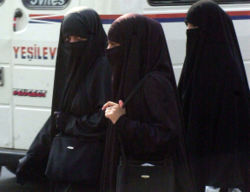
The first time (and thus far, the only time) I saw a woman in a niqab was in 1992 during a 10-day stay in Pakistan. Back then I knew practically nothing of Islamic traditions and regarded the wearing of the garment as nothing more than a simple expression of national pride. How wrong I was. [Addendum: I just remembered...during an overnight stopover in Egypt prior to landing at Karachi airport, my colleague and I went on a day tour, the other participants of which were several Pakistani women donning the black garb like the one in the photo here]

Food for thought on the subject of women, Muslim tradition, the West and the idea of banning the niqab could result in better understanding, or it could lead to more questions. Either way, learning is bound to happen, right? Excerpts:


William J. Bennett
To go after women donning their veils is to attack the problem at its weakest — and frankly, least important — link (again, when the veil is freely chosen). While Muslim women are being beaten, while honor killings are extant, and while mosques, universities, and madrassahs are fomenting actual terrorism, Muslim women assuming a dress code is not where our — or our allies’ — focus should be. Go after the men who do these things — that’s where the fight is.

I’m all for a terrorist profiling system for those that should receive extra scrutiny because they actually carry themselves, or look, like the enemy (including pat downs and further examinations of the suspicious) — but the entire female population of Islam cannot credibly be seen as the enemy, and those who assume the veil in Western societies may seem extreme, may be extreme, but if peaceful in belief and deed, they are not the enemy either. Indeed, it is a distraction from the real enemy to pick on what I assume a large percentage of these women are — seriously religious women who are not building bombs in their garages or study groups. To deny them the first right we boast, namely, the freedom to practice their religion peaceably, seems to me a good way to further radicalize them.

* * *

Phyllis Chesler
Western democracies pride themselves on religious freedom and on the separation of religion and state. From this point of view, we are upholding our own most cherished values by allowing diverse expressions of faith. However, this may also prove to be our downfall. The veil in Muslim lands is imposed upon women whose religious training and opportunities for scholarship and ritual authority is practically nonexistent. The veil is no more freely chosen than is their religion, which neither women nor men are allowed to leave without risking exile or death. Muslim women in Muslim lands or in immigrant communities in the West might gain their only access to public attention and approval if and when they espouse a fundamentalist point of view, namely one that favors Islamic gender and religious apartheid and that upholds the view that women must be veiled.

* * *

Andrew McCarthy
In the U.S., notwithstanding our veneration of both free expression and religious liberty, the regnant interpretation of the First Amendment holds that a religion-neutral law (i.e., one that does not expressly target a religion) is valid even if it happens to infringe on religious practices. The drug laws, for example, are valid even though that keeps peyote and cannabis away from sects which would use them in religious rites.

In terms of what the law can do, versus what a society should do, this gives clear guidance. For legitimate public purposes — e.g., testifying in court (where the fact finder must be able to make a discriminating appraisal of credibility which involves observing the witness’s demeanor), photographs for identification purposes (as on a driver’s license), inspection at a security checkpoint, etc. — the nikab would frustrate the public purpose. That public purpose is expressed in laws and rules that apply to everyone equally — they do not expressly target Muslims. Therefore, orders that the nikab be removed are proper. That doesn’t mean the nikab is illegal; the ban is situational.


More at National Review Online

Monday, November 06, 2006

Say it with stickers


ProLifeBumper.com


...and t-shirts


...and wristbands


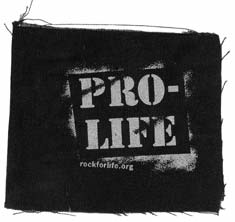
...and patches


Who's 'it'?

What do Chef, Parachute, Mickey Mouse, Popeye, and Egg have in common?

They're all part of the Game & Watch series of toys by Nintendo!! Remember those little electronic playthings? I think the first ones came out in the early 1980s and I remember getting full-swing into the craze (my favorite was Chef; for some reason, I took a liking to the toqued fella juggling sausages and what-have-you)! Alas, too many other kids became fans of the toy and schools decided that banning it was a good idea. *grimace*

It was a few years before that the chinese garter -- yet another favorite pastime of mine -- was banned at our school's grounds. From what I heard, some kid sustained a broken bone in an attempt to get past what I assumed was the #4 or # 5 level of the "modified high-jump." Hence, it was back to Agawan Panyo, Agawan Base and Chinese Jackstones after that.

And now schools in the States are banning tag??

Schools are banning tag. What's next: musical chairs?
By Dean P. Johnson


More and more elementary schools are banning the game of tag from playgrounds. Why? To prevent accidents (read: lawsuits) and to keep kids' self-esteem intact. But if physical harm and psychological harassment can be hidden in a simple game of tag, surely educational experts must be on alert for other forms of abusive playground games.

While patty-cake may seem innocent enough, who knows what's actually happening with all that slapping. And those rhymes! Why was Miss Mary Mack dressed in black, and what's up with this 50 cents to see an elephant jump so high it doesn't come back until the Fourth of July? Sounds like a drug-influenced song to me - something more likely heard at a Pink Floyd concert than at a playground.


Full story at The Christian Science Monitor

Saturday, November 04, 2006

Helping others to warm up

Charity knitters stitch up the world
In providing warm clothing to soldiers, third-world infants, and the needy, they comfort themselves as well.
By Marilyn Gardner | Staff writer of The Christian Science Monitor

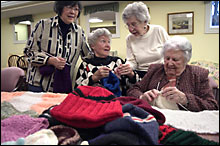
Laura Payson has always enjoyed knitting for others. As a college student, she made argyle socks for boyfriends. Later she turned her talents to baby clothes for relatives. Now she has a different focus: knitting for those in need. Every Saturday morning at 10, Mrs. Payson joins more than a dozen residents of the North Hill retirement community in Needham, Mass., for an hour of charity knitting. The women, known as the North Hill Knitters, stitch caps, mittens, scarves, and blankets for families who are homeless or struggling.


"I love to knit, and to know that I'm doing it for something worthwhile is really nice," Payson says as she knits and purls her way through rows of a yellow baby blanket bordered in white.


Across the country, groups like this are finding pleasure in what is sometimes called community knitting. Other knitters, including men, stitch at home and during lunch hours. Collectively they form an invisible army, creating afghans, caps for newborns, security blankets for ill or troubled children, and clothing to provide warmth and comfort.


Full story at The Christian Science Monitor


Related Posts Plugin for WordPress, Blogger...